Explore projects
-

A customizable and extendable change detection experiment written in Psychopy. Designed for the desktop.
Updated -
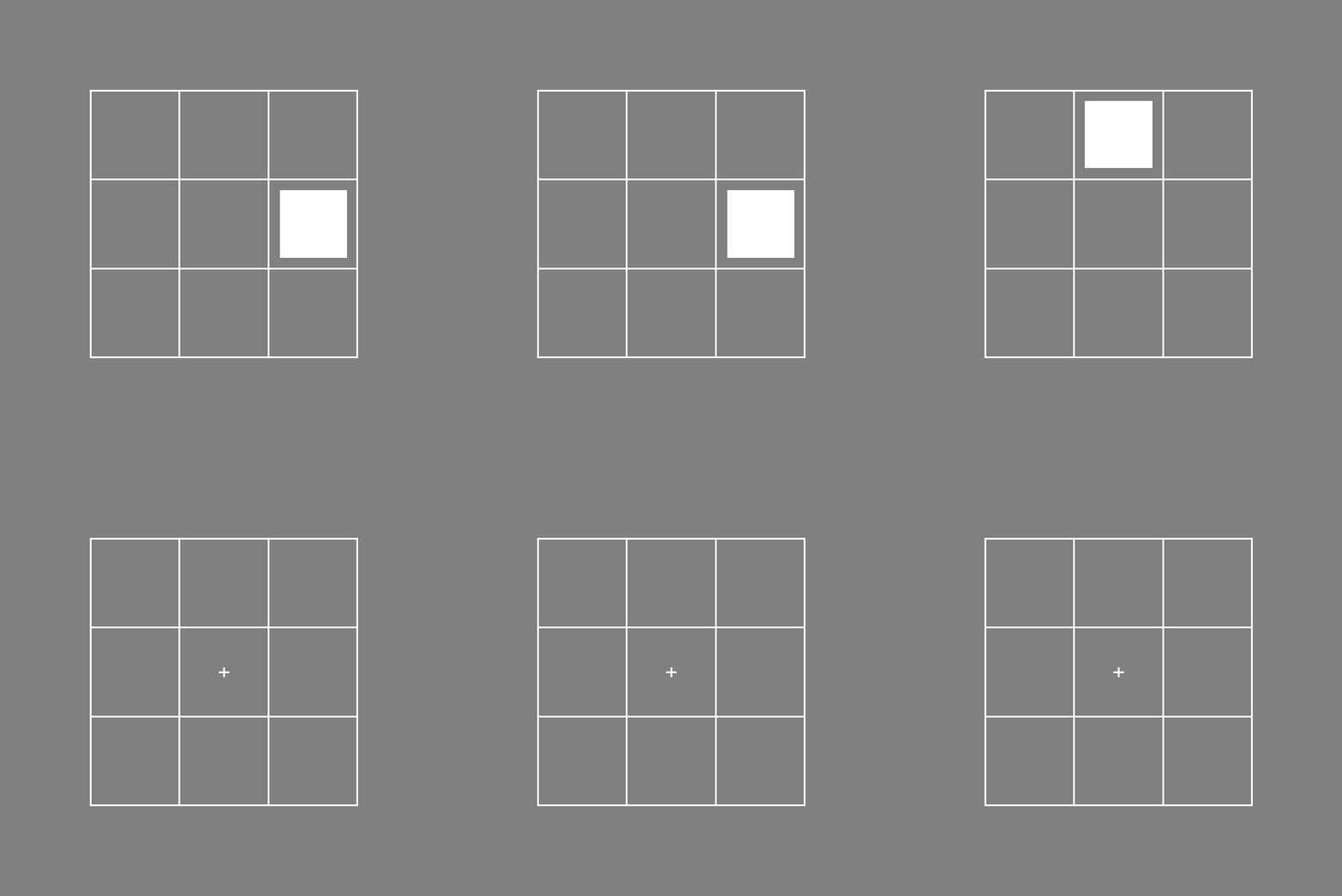
In this experiment participants are required to respond whenever the stimulus (square) location matches its location the previous trial (N-back-1). N-back-2 trials involve responding whenever the location of the square is the same as its location 2 trials before. This task is based on Kirchner (1958) experiment.
Updated -
-
-
This experiment is designed to measure participants' forwards, backwards, and sequential digit spans. It uses visual presentation. Sequence length increases every two trials. If participants make an error on both trials of the same length, they move onto the next trial.
Updated -
-

This task shows you the drag and drop capabilities of PsychoPy and PsychoJS. The demonstration uses a drag and drop puzzle game. The task requires you to drag and drop the black and white pieces into the empty square.
Updated -
Updated
-
Go/no-go task based on Redick et al.’s (2011) article “Working Memory Capacity and Go/No-Go Task Performance: Selective Effects of Updating, Maintenance, and Inhibition”.
Updated -
Updated
-
Updated
-
-
Updated
-
-
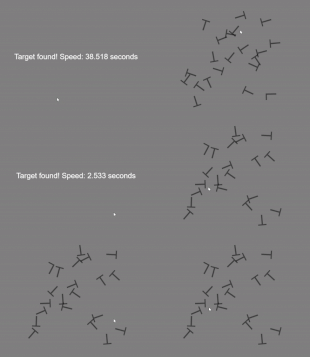
Demo of a visual search task for use online. User can manipulate setsize, target colour, letter orientation. Accuracy and response time recorded.
Updated -

In this task participants are required to memorise and recall number series in order. Participants start out with three 3-digit sequences. If participants correctly recall 2 out of 3 three sequences, they progress to 4-digit sequence trials and so on. If participants respond incorrectly on 2/3 trials the experiment terminantes. This experiment is based on the original digit span experiment by Jacobs (1887).
Updated -

In this task participants are required to press either left or right arrow key depending on which way the fish in centre is facing. Participants are required to ignore the direction of the surrounding fish. This is a children version of Flanker Task based on M. Rosario Rueda et al. (2004).
Updated -
The purpose is the test which kind of emotion affects memory Using images with relative music for test memory
Updated