Explore projects
-
safe and fast delivery, factory price, strong quality!!! Email:firstshop886@gmail.com Whatsapp/Skype/Telegram:+31 644739702
Updated -
safe and fast delivery, factory price, strong quality!!! Email:firstshop886@gmail.com Whatsapp/Skype/Telegram:+31 644739702
Updated -
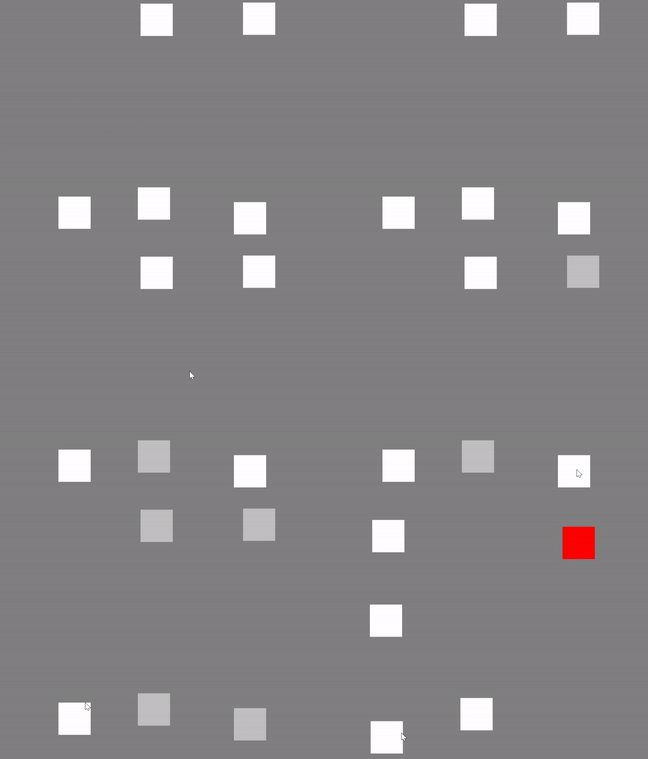
This task shows you the drag and drop capabilities of PsychoPy and PsychoJS. The demonstration uses a drag and drop puzzle game. The task requires you to drag and drop the black and white pieces into the empty square.
Updated -
-
-
This is a simple Lexical decision task. A fixation cross will be displayed in the centre of the screen. Following this 2 text stimuli will then appear, and the participant will have to respond if they are words or non words pressing ‘w’ if they are both words or ‘n’ if one or more is not a real word. This will be repeated 36 times for the main trial. Reaction time and accuracy will be recorded, and congruent and incongruent pairs will be compared. If you have any issues please get in touch with me at 19010167@hope.ac.uk Thank you Michael Dolan 19010167@hope.ac.uk
Updated -
Updated
-
Balloon Analogue Risk Task (BART)
The experiment: ——
This is a simplified (and prettified) version of the BART task by Lejuez et al (2002). Participants have to blow up a balloon that they know will burst at some point. They ‘earn’ rewards for getting the balloons to be larger, but increase the risk of bursting it, in which case they earn no reward for that balloon. The question is, how many times does someone pump each balloon trying to optimise their rewards.
The measure is designed to quantify individual differences in risk-taking.
Analysing your data: ——
You should filter out data where the balloon burst and measure the number of pumps made for the remaining trials.
Notes: ——
WARNING: This is an advanced demo involving lots of code components
This can be extended to be more similar to the original paper by adding further colours of balloons with different bursting profiles.
Updated -
-
Sustained Attention to Response Time Task (SART)
This SART task is modeled on the framework used in The Irish Longitudinal Study on Ageing (TILDA)
Participants must press a button (mouse or onscreen) in response to a series of digits and withold responses on the number 3)
Each digit appears for 300ms, with an interval of 800ms between digits. The cycle of digits 1–9 is repeated 23 times, giving a total of 207 trials. The task lasts approximately for 4min
Citations
Robertson I. H. Manly T. Andrade J. Baddeley B. T. Yiend J . (1997). ‘Oops!’: Performance correlates of everyday attentional failures in traumatic brain injured and normal subjects. Neuropsychologia, 35, 747–758. doi:S0028-3932(97)00015-8 [pii]
Aisling M. O’Halloran, Ciaran Finucane, George M. Savva, Ian H. Robertson, Rose Anne Kenny, Sustained Attention and Frailty in the Older Adult Population, The Journals of Gerontology: Series B, Volume 69, Issue 2, March 2014, Pages 147–156, https://doi.org/10.1093/geronb/gbt009
Updated -
Moves a pulsating circle around the screen like an eye tracker calibration cue. Paths are read from an Excel file but implemented in code.
Updated -
Updated
-
Updated
-
Updated
-
Check if the participant is using a mouse or touchscreen
Updated -
This experiment demonstrates how to count the number of words in a text box. It also demonstrates how to continue or stop a routine depending on the number of words the participant typed.
Updated -
Series of cognitive tests including: Verbal Fluency, Semantic Judgment Task, Forward Flow, Alternative Uses Task, Cattell, Demographics
Updated -
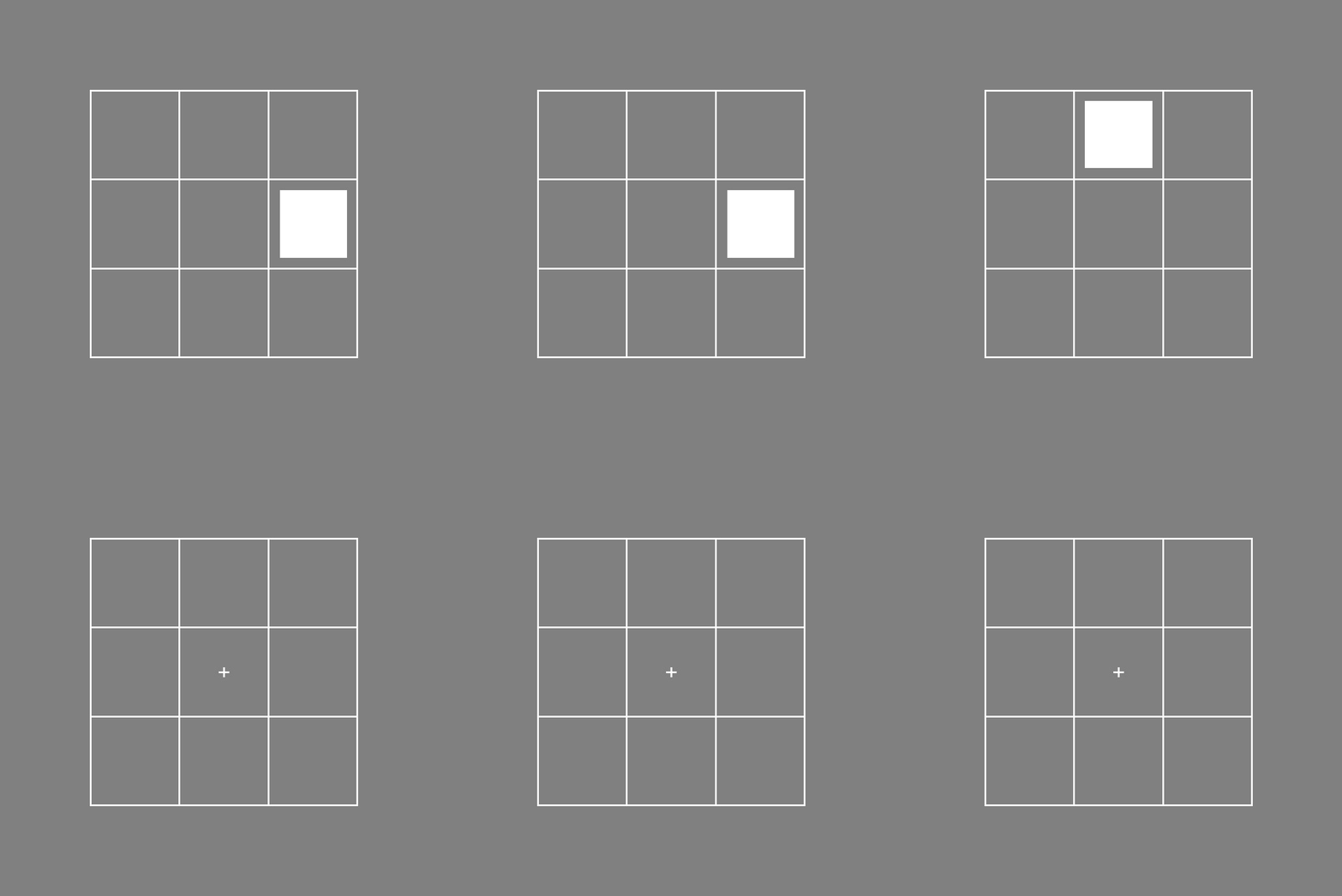
This is a demonstration of the trial types used for the manuscript: Merz, S., Spence, C., Frings, C. Need for (expected) speed: Exploring the indirect influence of trial type consistency on representational momentum
Updated -
-
Updated