Explore projects
-
Updated
-
-
-
The Choice Reaction Time Task (Deary & Liewald, 2011)
Updated -
-
-
Eksperimen ini bertujuan untuk mengklasifikasikan gambar-gambar wajah sesuai dengan emosi dasar manusia (terkejut, takut, jijik, marah, senang dan sedih).
Eksperimen terdiri dari dua bagian. Bagian PERTAMA, Anda diminta untuk menentukan emosi yang cocok/sesuai dengan gambar yang diberikan serta menentukan intensitas emosi pada gambar yang diberikan. Bagian KEDUA, Anda diminta untuk memilih satu kata emosi yang paling cocok/sesuai dengan gambar dari dua pilihan kata yang diberikan.
Eksperimen ini merupakan rangkaian dari validasi Human Basic Expressions Test yang dapat digunakan untuk seting klinis seperti pengukuran kemampuan pengenalan ekspresi wajah pada individu dengan Autism Spectrum Disorder.
Updated -
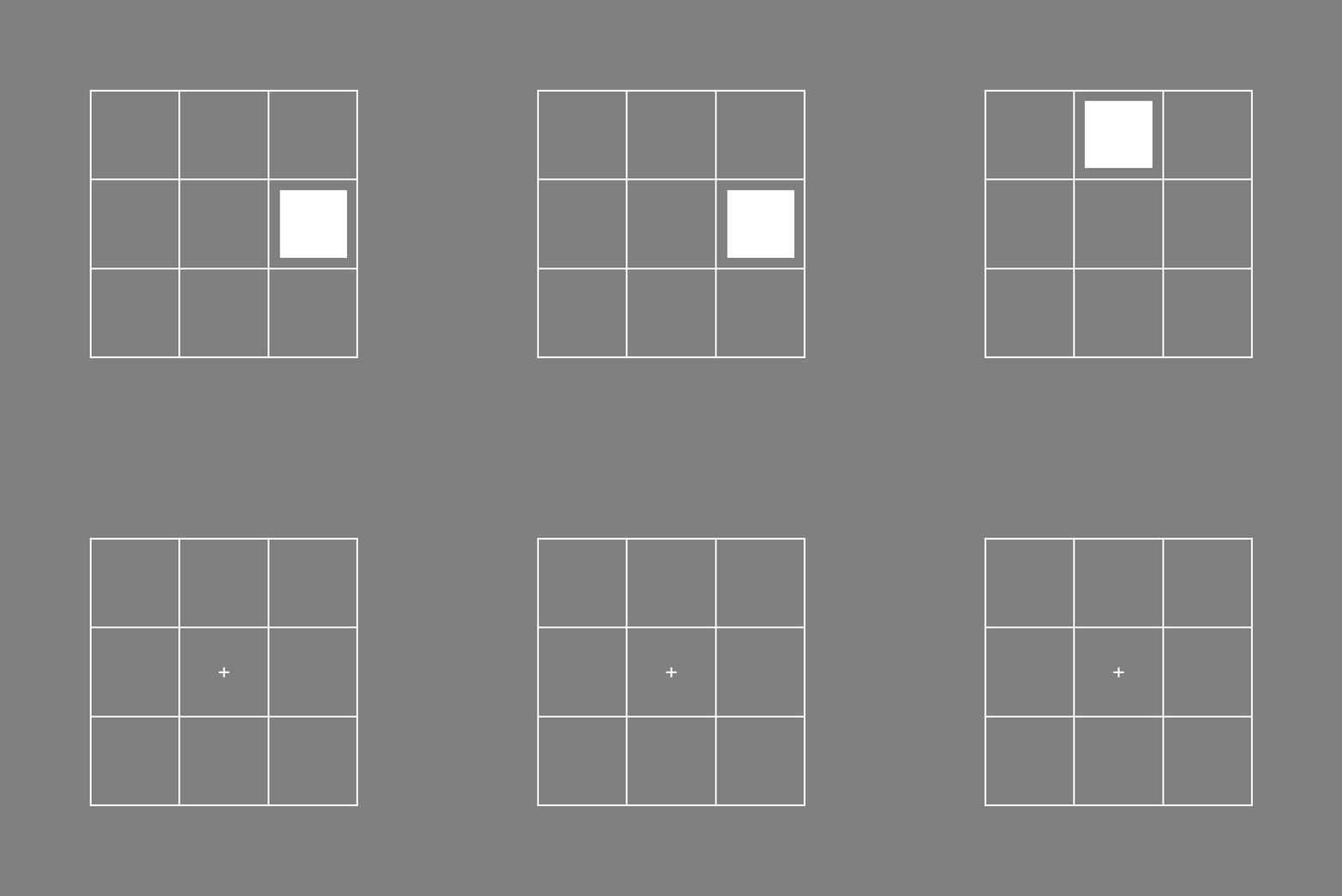
In this experiment participants are required to respond whenever the stimulus (square) location matches its location the previous trial (N-back-1). N-back-2 trials involve responding whenever the location of the square is the same as its location 2 trials before. This task is based on Kirchner (1958) experiment.
Updated -
Updated
-
Updated
-
Working memory tests on JavaScript (digit span, operation span, visual array, spatial span)
Updated -
Animal stroop task - based on Reynvoet et al 2021 and adapted for children In the Animal Stroop tasks, participants are instructed to respond to one piece of relevant information about a stimulus while ignoring the other, often more salient, piece of information. Two animals picture are presented on each trial simultaneously. Participants need to indicate which animal is larger in real life and ignore the size of the image. Two large animals (elephant or bear) coupled with two small animals (rabbit or butterfly) are presented. 1/2 congruent trials: the image of the larger real-life animal (elephant or bear) is larger than the smallest animal (butterfly or rabbit). 1/2 incongruent trials: the image of largest real-life animal is presented smaller than the image of the smallest real-life animal. Stimuli are a total of 16 pairs: 2 small animals x 2 large animals x 2 size (congr|incongr) x 2 sides (left|right) 16 practice trials with feedback; 48 test trials fixation cross 500ms Stimulus on the screen until a response is given. Blank screen 500ms Response: 'f' key for left, 'j' for right Inhibition is measured by an interference score for each task by subtracting the mean response time (RT)/mean accuracy on correct congruent trials from the mean RT/mean accuracy on correct incongruent trials.
Updated -
Updated
-
Dmitry Sukhoruchkin / guess_dot
GNU Affero General Public License v3.0Updated -
 Updated
 -
Updated
-

The Simple Reaction Time Task (Deary & Liewald, 2011)
Updated -
Updated
-

Participants are presented with a series of numbers and must recall them by typing them into a box. The amount of numbers will increase, making the task harder and harder until we can measure the maximum amount of numbers a participant can remember.
Updated