Explore projects
-
-
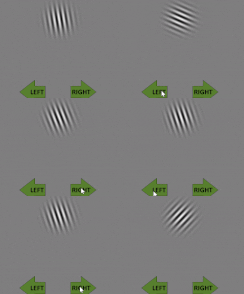
A basic demo of a psychophysics staircase, using orientation discrimination.
Updated -
CRISP Research Group / RISE-recognition
Creative Commons Attribution Non Commercial Share Alike 4.0 InternationalThis is a recognition test following the encoding test. Participants decide if images were seen before or presented together, in two parts: practice and trial. Based on this paper.
Updated -
Updated
-
Updated
-
In this task participants are required to sort the presented cards based on a rule. The rule is unknown to the participants, however they receive feedback whether their answer was correct. The rule changes after certain amount of trials. This experiment is based on Grant & Berg (1948) experiment.
Updated -
-
Updated
-
Updated
-
Updated
-
Updated
-
Updated
-
Updated
-
-
Sustained Attention to Response Time Task (SART)
This SART task is modeled on the framework used in The Irish Longitudinal Study on Ageing (TILDA)
Participants must press a button (mouse or onscreen) in response to a series of digits and withold responses on the number 3)
Each digit appears for 300ms, with an interval of 800ms between digits. The cycle of digits 1–9 is repeated 23 times, giving a total of 207 trials. The task lasts approximately for 4min
Citations
Robertson I. H. Manly T. Andrade J. Baddeley B. T. Yiend J . (1997). ‘Oops!’: Performance correlates of everyday attentional failures in traumatic brain injured and normal subjects. Neuropsychologia, 35, 747–758. doi:S0028-3932(97)00015-8 [pii]
Aisling M. O’Halloran, Ciaran Finucane, George M. Savva, Ian H. Robertson, Rose Anne Kenny, Sustained Attention and Frailty in the Older Adult Population, The Journals of Gerontology: Series B, Volume 69, Issue 2, March 2014, Pages 147–156, https://doi.org/10.1093/geronb/gbt009
Updated -
Updated
-
Basic Choice Reaction Time (CRT) created based on the paradigm used in The Irish Longitudinal Study on Ageing (TILDA)
Participants must click on the start button and are then presented with either the word "YES" or "NO". They must then click either YES or NO to correspond with the word presented onscreen. This allows seperation of the cognitive RT (time taken to start the movement) and the motor RT (time taken to complete the movement)
For citations from TILDA see:
Setti, A., Loughman, J., Savva, G. M., & Kenny, R. (2015). Trail Making Test performance contributes to subjective judgment of visual efficiency in older adults. PeerJ, 3, e1407. https://doi.org/10.7717/peerj.1407
Mosca, I., Wright, R.E. Effect of Retirement on Cognition: Evidence From the Irish Marriage Bar. Demography 55, 1317–1341 (2018). https://doi.org/10.1007/s13524-018-0682-7
Cronin et al., (2013) Health and Aging: Development of The Irish Longitudinal Study on Ageing Health Assessment Journal of the American Geriatrics Society https://doi.org/10.1111/jgs.12197
Updated -
In this task participants are tested on their iconic memory. Eight random letters (D, F, J, K) are presented in a circle for 100 ms and an arrow points to a letter participants are meant to memorise. This experiment is based on Lu et al. (2005) experiment.
Updated -
A basic demo of the sustained attention dots task.
Updated