Explore projects
-

A demo based on the Corsi blocks task. Tests Spatial memory. Participants must remember the order in which a series of blocks change colour.
Updated -
Updated
-
Updated
-

In this task participants are required to respond to all letter stimuli except from letter X (by pressing space). This task is based on Conners (2000) Continuous Performance Test.
Updated -

A minimalist antisaccade task measuring attention and response control, can be adapted for eye tracking.
Updated -
 Updated
 -
Experimental study mapping face perception in children (5+) using Multidimensional Scaling (MDS) and attitude measures. To minimize fatigue, it uses a BIBD design (66 random pairs from 20 stimuli across 4 ethnicities). It explores the link between physical similarity and social bias. Built with jsPsych for Pavlovia/GitHub.
Updated -

-

Participants are presented with a series of numbers and must recall them by typing them into a box. The amount of numbers will increase, making the task harder and harder until we can measure the maximum amount of numbers a participant can remember.
Updated -
Updated
-
Updated
-
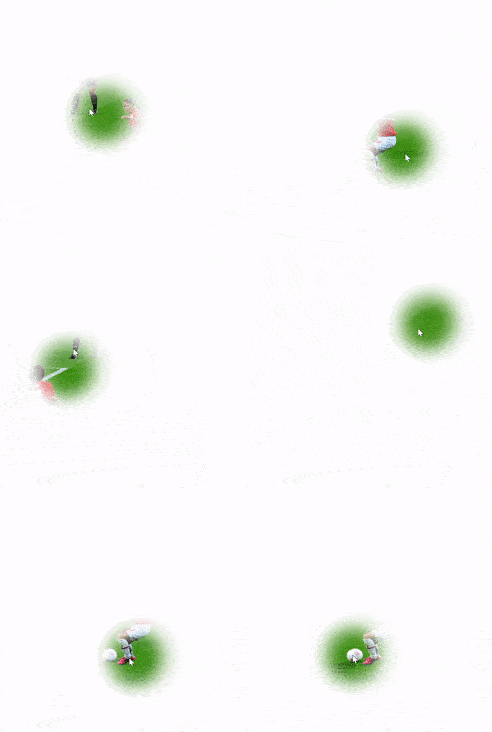
Use the mouse to control what part of an image you can see. This demo shows you how easy it is to build rich dynamic studies using only the Builder view.
Updated -
Updated
-

A demo based on the Bilingual Stroop effect. Also demonstrates how to achieve a counterbalanced design.
Updated -
-

-

A demo based on the Glasgow Face Matching task. Used in the study of face perception.
Updated -

A basic demo of a psychophysics staircase, using orientation discrimination.
Updated